


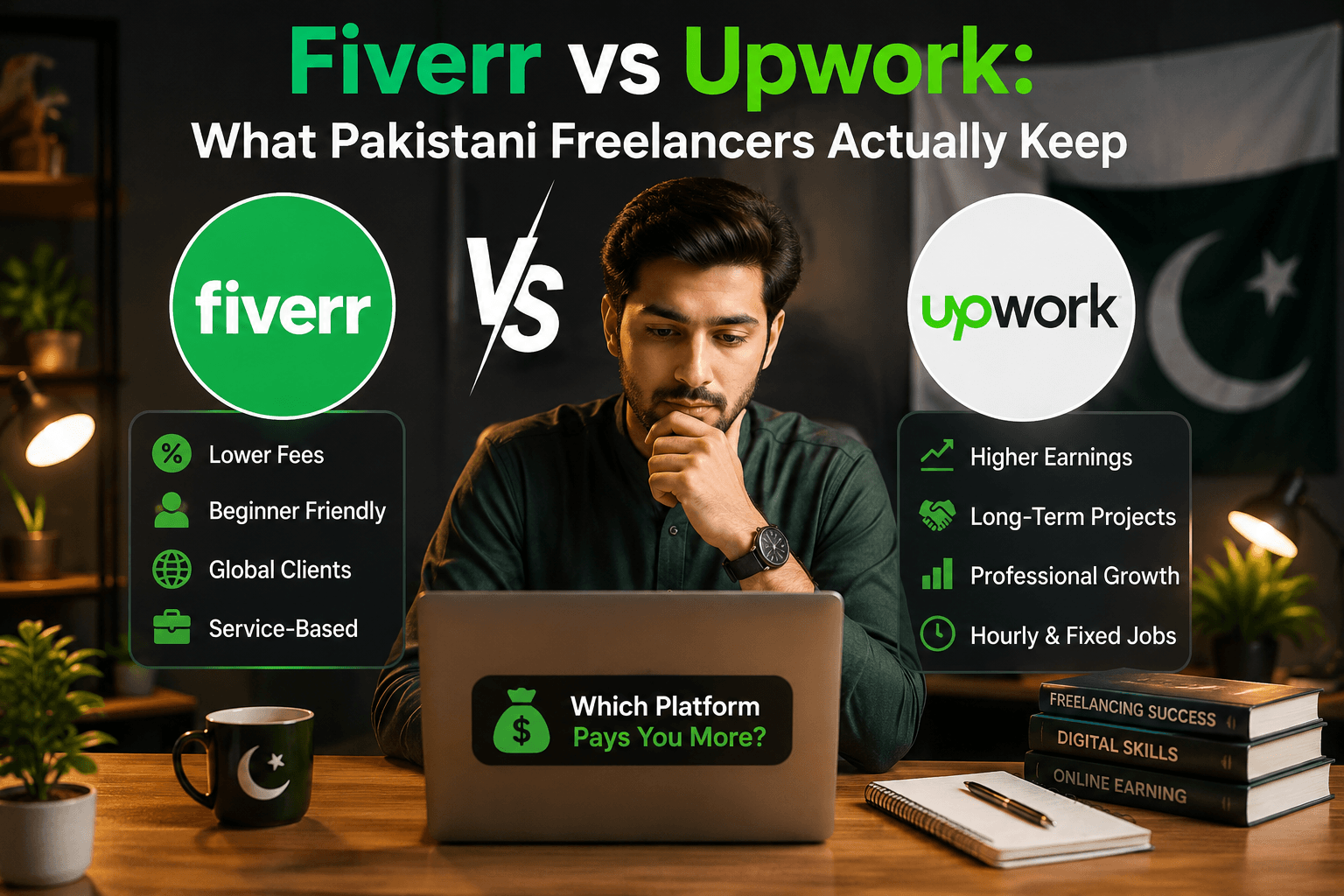
Fiverr takes 20%. Upwork takes 10%.
If that settled it, this would be a very short article. It doesn’t, because the 10% is the only Upwork fee anyone counts — and by the time dollars have become rupees in a Karachi bank account, the two platforms are far closer than they look.
There is also a second question nobody writing for an international audience asks: in Pakistan, how you take the money out changes your tax rate, not just your fees.
What actually lands from a $1,000 contract
| Line item | Fiverr | Upwork |
|---|---|---|
| Gross contract | $1,000 | $1,000 |
| Platform service fee | −$200 (20% flat) | −$100 (10% typical) |
| Cost of winning the work | $0 | −$5 to −$15 (Connects) |
| Withdrawal fee | −$1 to −$3 | −$0.99 local bank / −$30 wire |
| Currency conversion (USD→PKR) | −1.5% to −4% | −1.5% to −4% |
| Roughly what reaches your bank | $765–$785 | $845–$880 |
| Effective total cost | ~21–23% | ~12–15% |
Upwork still wins on a single clean $1,000 contract. But the gap is roughly 8 percentage points, not the 10 the headline numbers imply — and it narrows further with every proposal you send to win the job.
Fiverr: 20%, and 20% means 20%
Fiverr charges sellers a flat 20% on every order. No tiers, no loyalty discounts, no reduction for long-term clients or large orders. You see the fee before you accept.
The predictability is worth something real. You can quote a price and know your take-home immediately, and an order you did not win costs you nothing because there is no per-proposal charge.
Your only extra costs are the withdrawal fee — typically $1 to $3 to a local bank — and currency conversion.
Upwork: the 10% is not the whole number
Upwork’s service fee is where published guidance stops agreeing with itself, so read your own contract rather than any article.
Some current sources describe a flat 10% on all contracts. Others describe a variable per-contract fee of 0%, 5%, 10% or 15%, set by work type and demand and introduced in May 2025. Both agree most freelancers land near 10%, and that the rate is shown before you submit a proposal. Trust the figure on the job posting.
The surrounding costs matter more:
Connects
Every proposal costs Connects at roughly $0.15 each, with a typical proposal consuming several. At a 10% win rate, one client can cost $7 to $9 in Connects alone. That is a real cost of doing business on Upwork, and it does not exist on Fiverr.
Withdrawal
Direct to local bank is around $0.99 per transfer. A wire is $30. PayPal is about $2. Withdraw weekly instead of monthly and you pay the fee four times as often for no benefit.
Currency conversion
This is the one that goes unnoticed. Upwork pays in USD, and converting to PKR costs roughly 1.5% to 4% depending on route. Upwork uses its own exchange rate rather than the mid-market rate, and the margin is not published.
On a $5,000 withdrawal that spread is $75 to $200 — and it appears nowhere on your dashboard as a fee. It is simply a smaller number arriving in your account.
The part specific to Pakistan
Conversion is where a Pakistani freelancer loses the most, and it is also the most fixable.
Holding USD rather than converting inside the platform generally beats the platform’s rate. A USD-denominated account lets you take the money out in dollars and convert separately, where you can see what you are getting — though which of those accounts is actually available from Pakistan is a more complicated question than most guides admit.
Two habits are worth more than choosing the “cheaper” platform:
- Withdraw monthly, not weekly. Same money, a quarter of the withdrawal fees.
- Convert deliberately. Compare the offered rate against mid-market before accepting it.
Your withdrawal route also sets your tax rate
This is the connection most freelancers miss. Under Section 154A, IT and IT-enabled export income qualifies for a concessional final tax rate — but only if the money reaches Pakistan through a proper banking channel. Payments routed informally do not qualify at any price.
So the withdrawal decision has two variables, not one. Saving 1% on conversion while disqualifying yourself from the concessional rate is a bad trade. The full rate table is here — the spread between the top and bottom row is larger than anything either platform charges you.
Which platform is cheaper for you
It depends on how you win work, not on the percentage.
Fiverr costs less if you receive repeat orders, work in small volumes, or would spend heavily on Connects to win the same work elsewhere. A predictable 20% with zero acquisition cost beats a 10% fee you spent $15 in proposals to reach.
Upwork costs less if you win long-running contracts, have a high proposal-to-win ratio, or work on larger projects where the percentage saving outweighs the fixed costs.
The honest calculation is not fee against fee. It is: what did it cost you, in total, to earn your last $1,000 on each platform — including the proposals that went nowhere?
Frequently asked questions
How much does Fiverr take from freelancers?
A flat 20% on every order, with no tiers or discounts regardless of order size or client history. Withdrawal fees of roughly $1 to $3 and currency conversion apply on top, bringing the real cost to about 21–23% for a freelancer withdrawing to a Pakistani bank.
Does Upwork really only take 10%?
The service fee is around 10% for most contracts, but it is not the total cost. Connects spent on proposals, withdrawal fees, and a currency conversion markup of roughly 1.5% to 4% bring the effective cost closer to 13–18% for freelancers outside the US.
Is Fiverr or Upwork better for Pakistani freelancers?
Neither is universally cheaper. Fiverr’s flat 20% with no proposal costs suits smaller or repeat orders. Upwork’s lower service fee suits larger, longer contracts if you win work without spending heavily on Connects. Calculate your own total cost per $1,000 earned rather than comparing headline percentages.
Fee figures compiled September 2026 from published platform rate information and third-party fee guides. The $765–$880 range is modelled from those published rates, not measured from a single payout. Platforms revise fee structures periodically — confirm current rates with Fiverr and Upwork directly.

3 Comments
Pingback: Payoneer vs Wise Pakistan 2026: Real Fees Compared
Pingback: Withdraw to a Pakistani Bank: Timelines and PRC Guide
Pingback: Getting Paid as a Freelancer in Pakistan (2026 Guide)